

From Shimonoseki to the current crisis: China, Japan and Taiwan
On February 8, the results of the general elections in Japan were made public. The bet to bring forward the elections made by the leader of the Liberal Democratic Party (LDP), Sanae Takaichi, ended up being fruitful, providing the party with the largest majority (in percentage terms) in the history of modern democracy in Japan.
This triumph comes in the midst of a diplomatic crisis between Japan and the People's Republic of China that broke out months before. The tension began on November 7, 2025, two weeks after Takaichi first took office, when declared he told the National Diet that an “emergency in Taiwan” would threaten Japan's survival.
Following Takaichi's statements in November, Beijing responded aggressively: it demanded a retraction, imposed restrictions on Japanese seafood imports and, from its consulate in Osaka, launched threats on social networks, taking bilateral relations to their lowest point in years.
The Japanese government held stated that these statements did not constitute a break in foreign policy with respect to China, but rather a continuity with the official line maintained since Joint Communiqué of the State of Japan and the People's Republic of China of 1972, where Japan “understands and respects” Beijing's position that Taiwan is part of China.
But why does Taiwan matter in this context?
A history of tensions
The role that Taiwan and its archipelagos have had is an aspect not always explored in Sino-Japanese relations (and tensions). Curiously, Taiwan's history has often been separate from the continental empire: inhabited by Austronesian peoples and coveted by several European powers in the 16th and 17th centuries, Taiwan was not integrated into the Chinese administrative orbit until the 17th century. In 1683, the Qing Empire assumed administration of the island, limited by distance, geographical complexity, and a heterogeneous society made up of Austronesian communities and migrant traders around its ports.
However, it was not until 1887 when Beijing declared it a province, because it was a strategic point.
Meanwhile, a military-rising Japanese empire coveted the islands. As a consequence of the first Sino-Japanese War (1894-95) in which Japan militarily defeated China on several fronts and quickly, Tratado de Shimonoseki 1895 redefined island sovereignty. The Qing Empire ceded Taiwan and the Pescadores (Penghu) Islands to Japan. With this treaty, Taiwan would become a Japanese colony for 50 years.
Under Japanese rule, the island experienced an economic transformation and modernization that contrasted with continental instability. While the mainland fragmented with the fall of the Qing government, Taiwan developed under a modern administrative system. The colonial government created a series of infrastructures that, after its unconditional surrender in 1945, would serve as the basis for the administration of the Republic of China. An example of this is the Taiwanese Legislative Yuan, moved in 1960 to the building of the former girls' school and boarding school of the School Affiliated with the Office of the Japanese Governor General.
End of a world war and continuation of a civil war
After the Japanese defeat in 1945, the Chinese Nationalist Party (KMT) Republic of China retook Taiwan. In mainland China, the civil war, which began in 1927 and was paralyzed in 1937 by the total Japanese invasion (Second Sino-Japanese War), resumed in 1945 after the Japanese withdrawal. Four years later, in 1949, the communist victory on the mainland forced the exile of Chiang Kai-shek, leader of the KMT, and his government and military to the island. Since then, despite the fact that both republics claim to be the heir of China “legitimate”, both sides of the strait begin to follow radically different paths.
In Taiwan, the nationalist project led to a one-party government in fact under martial law and political repression. On the continent, the Chinese Communist Party consolidated an authoritarian regime marked by political campaigns and enormous-scale catastrophes, such as the Great Leap Forward, its subsequent famine, and the Cultural Revolution.
Decades later, both systems transformed to survive. On the mainland, Deng Xiaoping initiated Reform and Opening Up in 1978, reorienting the economy without giving up political control. In Taiwan, after the death of Chiang Kai-shek in 1975, his son Chiang Ching-kuo bowed to internal and external pressures, culminating in the end of martial law in 1987 and the first direct presidential elections in 1996.
These divergent histories, marked by an unfinished civil war, mean that both sides of the strait share heritages from that revolutionary China, but consecrate them in different ways. Precisely, this historical legacy conditions the current tensions between the governments of Japan and China.
Geopolitics of legitimacy: spheres of influence
As we have seen, Taiwan was controlled by the Chinese imperial administration from 1683 to 1895 and by the mainland Republic of China from 1945 to 1949. In total, 216 years of government based on the mainland. At the same time, it should be emphasized that the nature of the Qing administration was diffuse and peripheral. During most of Qing rule, effective control was restricted to the Pescadores (Penghu) Islands and a narrow strip of the western coast, while the mountainous interior and much of the eastern coast of the island remained under the autonomous rule of the Austronesian peoples.
As a consequence of this diffuse and weak control, the Japanese Empire invaded the south of the island in 1874, expanding its control from the Ryukyu Islands. Following the payment of a large indemnity to Japan and the French invasion of Keelung in 1884, the Qing Empire decided to expand its control towards the mountainous interior and the east coast and, once assuming control of the island, ended up granting the island the status of a province in 1887.
When Japan ceded the island to the government of the Republic of China in 1945, during a deep economic crisis marked by inflation, the KMT imposed a military-infused authoritarian government. At the same time, the growing arrival of KMT soldiers escaping from the mainland fueled a deep social fracture between the locals and the newcomers, which would worsen once Chiang Kai-shek imposed martial law on the island.
Today, the Chinese Communist Party bases its claim on the island on a story of historical and ethnic legitimacy: Taiwan is an inseparable part of the Chinese nation that must be “reunified.” This contrasts with the logic of other powers in their respective spheres of influence. In the Caribbean, the United States exerts influence not through claims of historical sovereignty, but through a pragmatic security doctrine where its control is vital to its defense, regardless of the historical identity of its neighbors. China, on the other hand, does seek the restoration of a territorial integrity perceived as historically sacred.
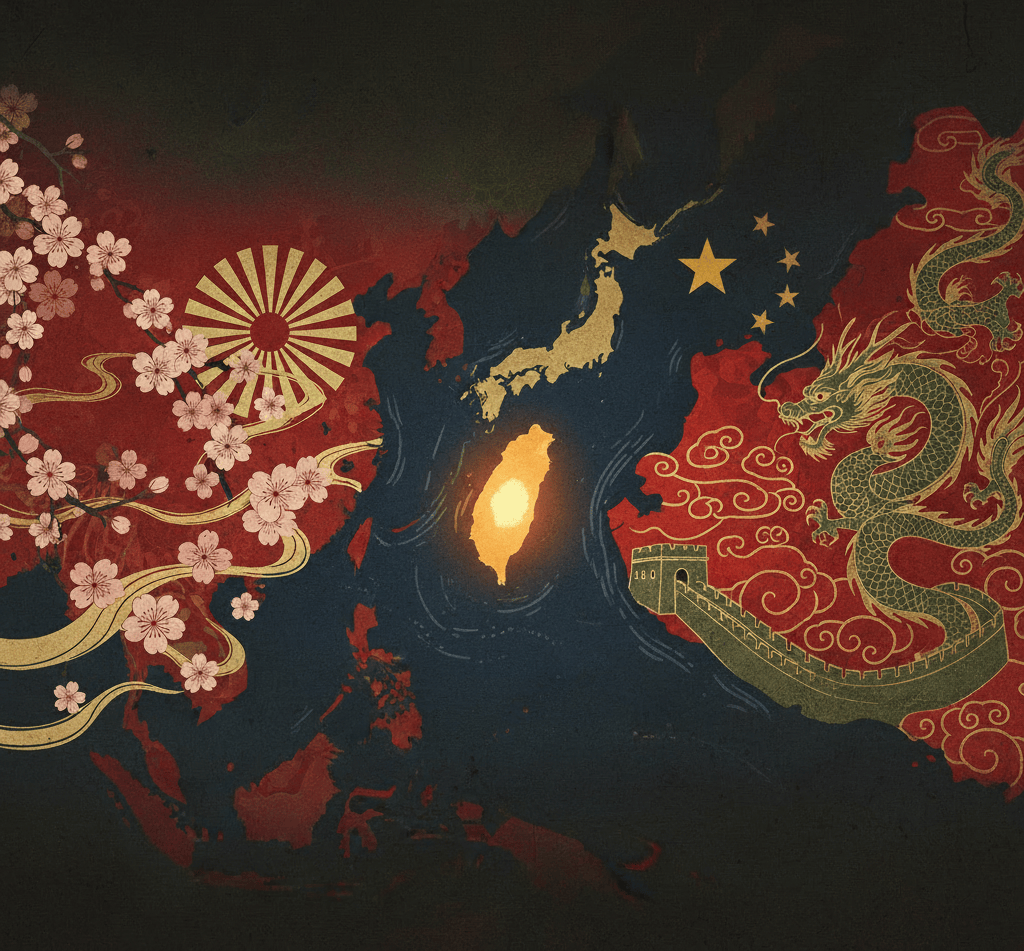
In the middle of this board is Japan, which sees Taiwan as an ally and as the most like-minded country among its neighbors. Among the countries in the area, Taiwan and Japan not only share excellent unofficial relations, since Japan does not recognize the island as an independent country, but they also have a shared history. It should also be noted that the Japanese island of Yonaguni, the westernmost of the archipelago, is located just 110 kilometers from the Taiwanese coast. In fact, on clear days, Taiwan's mountains are visible from Japanese soil. This proximity means that any change of sovereignty on the island can be seen by the Japanese government as a possible strategic risk. Therefore, it is understandable that Japan sees Taiwan's destiny as linked to its own.
***
Jose Soria

About the author: José Soria has a bachelor's degree in International Relations and Economics from Brown University and a master's degree in International Relations from Johns Hopkins University. During his degree, José specialized in China and has carried out study and work stays in Beijing, Shanghai, Guangzhou and Taipei. Apart from speaking Chinese, José also speaks Japanese, French, Russian and English.