



Stablecoins and the Transatlantic Policy Divide: the Future of Global Governance of Digital Currencies from a US and European Perspective
Washington D.C. – The United States took a decisive step to define the future of digital money by enacting ley GENIUS (Guiding and Establishing National Innovation for U.S. Stablecoins) and Anti-CBDC Surveillance State Act. Together, these legislative milestones reflect a distinctively American approach: encouraging private-sector stablecoins innovation and rejecting state-run digital currency systems.
The American Approach: Innovation and Limited Regulation
ley GENIUS defines stablecoins or stablecoins as digital assets pegged 1:1 to fiat currency and used for payments. Only certain financial entities with less than $10 billion in circulation can issue these currencies, as long as they maintain reserves in U.S. dollars or Treasury bonds, undergo regular audits, and comply with AML/CFT regulations. The law also ensures that these currencies are not classified as securities or commodities, placing oversight in the banking system rather than financial markets.
In parallel, the ley Anti-CBDC Surveillance State Act project seeks to prohibit the Federal Reserve from issuing a CBDC (Central Bank Digital Currency, or Central Bank Digital Currency), directly or indirectly, to individuals, citing concerns about financial surveillance, programmability and government overreach. This makes the US the only G7 country to explicitly reject a retail CBDC model, in favor of stablecoinsmarket-based ones as digital representations of the dollar.
To better understand some of these terms, it is useful to define what a stablecoin is. It is a type of crypto asset whose value is designed to remain stable relative to a specific asset or set of assets. Unlike other cryptocurrencies, such as Bitcoin or Ethereum, whose value can fluctuate significantly due to speculation and market supply and demand, stablecoins seek to minimize volatility. They are electronic, peer-to-peer and are not issued by central banks. These digital currencies use various strategies to achieve this stability, including the reserve of underlying assets, stabilization algorithms, and centralized or decentralized governance.
Fiat-backed stablecoins are the most common and well-known, as they are collateralized by a reserve of one or more traditional currencies. Notable examples include Tether (USDT) and Circle (USDC), which are backed by reserves equal to their value in US dollars. These two entities control the vast majority of US dollar stablecoins currently issued.
The stablecoins seek to be adopted as a means of payment for online purchases, peer-to-peer transactions, micropayments, remittances and various future applications. Furthermore, they have the potential to serve as a digital monetary instrument for integration into blockchain-based applications, such as programmable money or smart contracts. blockchain technology allows these transactions to be recorded securely and transparently, creating an immutable history that does not depend on a central intermediary. This allows stablecoins to be used reliably in digital environments, ensuring traceability and security.
Thanks to its stability, have become a preferred means of exchange within the cryptocurrency ecosystem, facilitating faster and cheaper transactions compared to traditional fiat currencies. The estimated market capitalization of stablecoins for May 2025 was $245 billion, with those linked to the dollar dominating the market with more than 90% of the total.
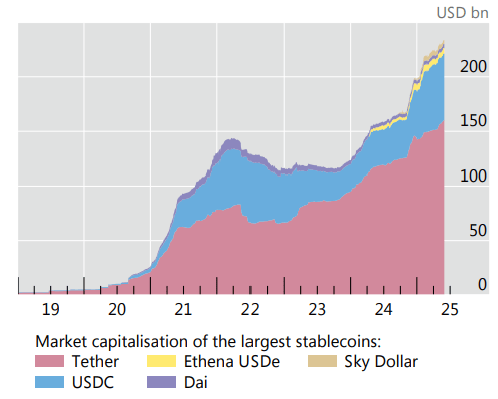
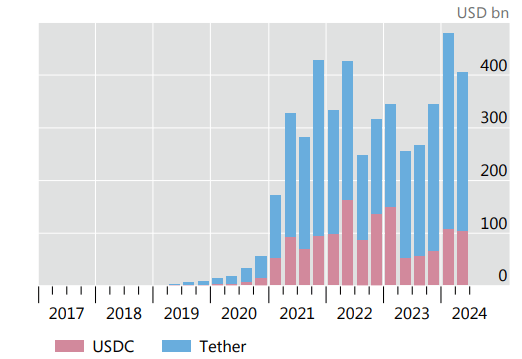
Fuente: Bank for International Settlements. (2025). BIS Annual Economic Report 2025. https://www.bis.org/publ/arpdf/ar2025e3.pdf
The European approach: regulation and monetary sovereignty
On the other side of the Atlantic, the European Union (EU), through the Crypto Asset Markets Regulation (MiCA) and the ongoing Digital Euro project, is charting a very different course. It aims to enable the regulated issuance of stablecoins while actively developing a central bank-backed digital euro, with the aim of maintaining monetary sovereignty in a digital environment while providing a secure and efficient means of payment for citizens.
The MiCA framework, effective from mid-2025, offers a unified approach for cryptoassets, stablecoins (ART and EMT) and their issuers. It requires those issuing euro-denominated stablecoins, including banks and electronic money institutions, to comply with strict reserve, disclosure and authorization standards. Unlike ley GENIUS, MiCA does not exclude stablecoins from being considered financial instruments or electronic money. In addition, the EU is promoting a Digital Euro, a public CBDC issued by the European Central Bank, which is currently in its legislative phase. This project seeks to provide public access to digital money, complementing physical cash in euros and connecting private stablecoin ecosystems with central bank money.
A CBDC is a digital form of fiat currency issued directly by central banks. Unlike private cryptocurrencies, which are decentralized and operate on blockchain networks without intermediaries, CBDCs are managed by a central authority, the issuing central bank. These would represent a new type of central bank money, combining the digital nature of deposits with the use of cash in peer-to-peer transactions.
Currently, 137 countries and monetary unions, representing 98% of the global economy, are exploring CBDCs. Seventy-two countries are in the advanced exploration phase (development, pilot or launch), and three countries have fully launched this type of currency (Bahamas, Jamaica and Nigeria). The largest launch has been digital yuan or e-CNY in China, reaching more than 180 million personal wallet users and with a cumulative transaction value of 7.3 trillion RMB (approximately $1 billion) in just four years of pilot testing.
What are the consequences of these different approaches?
The differences between the approaches of the US and the EU are marked and transcendental, and their divergence goes beyond the regulatory: it reflects different ideologies about the future of money. While the US seeks to limit state control, maximize innovation and consolidate the global primacy of the dollar through private stablecoins, Europe aims to preserve monetary sovereignty, protect users and consolidate innovation within the existing financial architecture.
New US legislation restricts access to foreign stablecoins, so euro-denominated tokens could face barriers to accessing this market. This could consolidate the dollar's leadership in digital payments and marginalize the euro in global stablecoins ecosystems. The lack of harmonized regulatory frameworks can hinder global interoperability.
In this sense, it would be important for European authorities to promote mutual recognition frameworks that allow issuers of euro stablecoins to comply with US standards through bilateral agreements. These frameworks should be aligned with both technical and legal infrastructures (accounting protocols, messaging standards, anti-money laundering data sharing and public participation, etc.) and pilot corridors that comply with the principles of the MiCA and GENIUS laws.
That said, it is important to highlight that there are also risks associated with the privatization of digital money following the US approach. As mentioned, most US-based stablecoins have been issued by two companies, and now large financial institutions, such as JP Morgan Chase, are following suit.
The growth of cryptocurrencies raises challenges for monetary policy and financial stability in an environment where they coexist with fiat currencies. If a significant portion of the population uses stablecoins issued by private companies, central banks could lose control over the money supply, which would affect their ability to manage inflation or adjust interest rates, as well as their ability to manage a given economic cycle. At the same time, if citizens prefer to use these digital currencies instead of deposits in traditional banks, commercial banks could lose deposits, which would reduce their ability to grant credit and cause banking disintermediation, reducing liquidity in the economy. This is why many economists argue that a public CBDC would serve as a necessary anchor, allowing central banks to preserve monetary sovereignty in a digitalized and fragmented financial system.
In conclusion, the introduction of digital currencies is perhaps the most important advance in the monetary economy of the last decade. In this new phase of monetary globalization, digital sovereignty, financial openness and cross-border regulatory interoperability will define the winners and the laggards. Decisions made in Washington, Brussels and Beijing over the coming months could shape the monetary infrastructure for generations to come.
***
Carlos Sánchez Reboiro

About the author: Carlos Sánchez Reboiro works as a global digital finance specialist for IFC, the private investment arm of the World Bank, where he drives digital finance strategies to expand financial inclusion in emerging markets around the world. He is an experienced investment professional with a decade of experience in the financial sector, where he has led pioneering investments in technology companies and venture capital funds in Asia, Africa and Latin America, promoting the development of sustainable financial systems. Carlos has two master's degrees in public policy and international business management and specialized training in venture capital, artificial intelligence, economic development and decentralized finance.
Contact details:
- Personal e-mail: carlosanchezr@10gmail.com
- Work e-mail: csanchezreboiro@ifc.org