

Spain and China: how to take advantage of Chinese investment without compromising our industry?
This November marked twenty years since the signing of Agreement for the promotion and reciprocal protection of investments between the People's Republic of China and the Kingdom of Spain. Coinciding with this anniversary, the Kings of Spain made an official visit to the Asian country, reflecting a bilateral relationship that has intensified through trade treaties, agri-food agreements and cooperation mechanisms in areas such as science, culture or education, and even a Extradition Treaty signed in 2005.
However, this approach takes place in a European context radically different from that of two decades ago. On December 3, the European Union (EU) updated issued its Economic Security Strategy, warning of the risks associated with certain Chinese trade policies and the growing systemic rivalry between China and the United States. This new reality forces us to rethink the fit of the bilateral relations of Spain and China within the European framework.
For this reason, the question that arises is clear: how should Spain manage its commercial relationship with China, maximizing commercial benefits without compromising its economic and industrial security?
From the commercial opening…
Since the 1990s, growing economic integration between the EU and China has allowed European companies to access the largest market in the world and significantly reduce the costs of their manufacturing through global value chains. However, this trade integration has also had adverse effects. Various studies, including a study from BCE in 2022, have documented a net loss of manufacturing employment in the EU associated with the increase in Chinese imports and productive relocation, a phenomenon known as China Shock.
At the same time, Europe has become one of the main destinations for Chinese investment, especially after Xi Jinping came to power in 2012 and the launch of the Belt and Road Initiative, known in English as Belt and Road Initiative. Strategic projects such as acquisition of the port of Piraeus or 16+1 program, called 17+1 after the accession of Greece, initially showed an increasingly closer relationship.
…to caution
However, in recent years, the European stance towards China has been evolving to a more cautious position. The effects of the lockdown in China during the COVID-19 pandemic significantly reduced its exports to Europe and reduced investment by European companies in the country. This, combined with China's economic and diplomatic support for Russia's invasion of Ukraine, led to certain changes in EU-China relations. The suspension of Comprehensive Investment Agreement (CAI), the departure of several Member States from the 17+1 format and the tightening of the European speech reflect an emerging consensus: China is simultaneously a partner, economic competitor and systemic rival.
This shift has resulted in in anti-subsidy investigations, antidumping measures and the promotion of initiatives such as Global Gateway, aimed at reducing strategic dependencies and strengthening European industrial autonomy in the face of a possible China Shock 2.0.
And Spain?
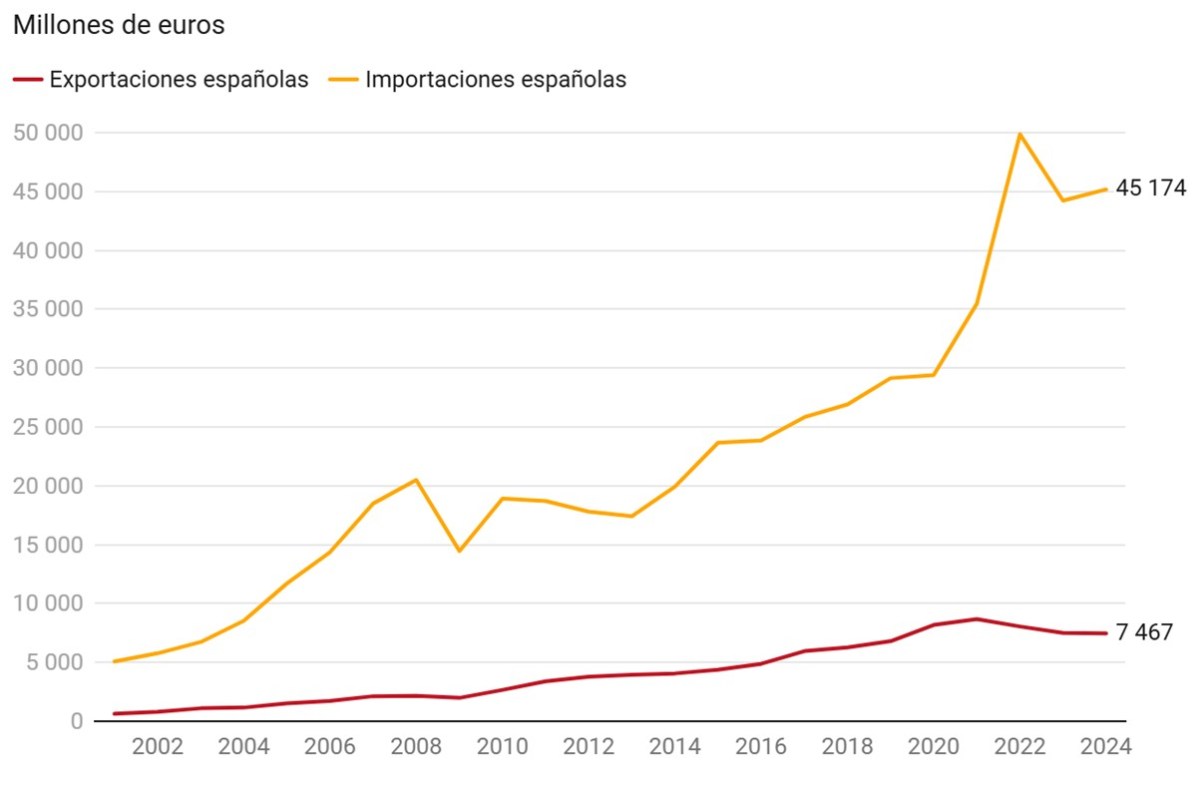
This has been accompanied by a structural trade deficit with China, which in 2024 stood at approximately 37,706 million euros, calculated as the difference between Spanish imports from China (45,174 million euros) and Spanish exports to the Asian giant (7,467 million euros) according to official data from Spain China Council Foundation. In turn, several studies academics point out that growing price competition from China has contributed to the deterioration of manufacturing employment in several European countries, including Spain.
At the same time, Chinese direct investment in Spain, despite still being limited in aggregate terms compared to the main traditional investors such as the United States, France or Germany, has gained relevance due to its strong concentration in strategic industrial sectors, especially in electric vehicles and battery manufacturing. This context includes large-scale industrial projects such as the partnership between CATL and Stellantis for the manufacture of electric car batteries in Barcelona and Zaragoza, the production plans of the Chinese automobile manufacturer Chery in Barcelona and the application of BYD to build another electric car factory in Spain.
Risks for Spain: the African and European precedent
In order to evaluate the possible benefit of these investment promises, it is advisable to refer to previous experiences of Chinese investment in other regions, not as models that can be directly extrapolated to the European context, but as starting points to identify recurring patterns and paradoxes. The case of Ethiopia is illustrative. There, Chinese investment exceeded 8.5 billion dollars in 2024, making the country one of the main recipients of Chinese capital from the Belt and Road Program in Africa. However, a 2022 World Bank report on industrial development projects concludes that industrial parks developed with Chinese capital have been largely concentrated in activities with low specialization and little added value, especially in the textile sector. Similarly, World Bank BRI-related Review (2019) documents a high prevalence of hiring Chinese workers and suppliers in projects linked to the Belt and Road Initiative, which limits technology transfer and reduces the positive impact on the local productive fabric.
In Spain, some similar signs invite caution. CATL's recent statements statements about the need to relocate up to 2,000 Chinese workers to its plant in Zaragoza reinforce the fear that these investments are dedicated to the assembly of imported components, with low technological transfer to the local business landscape. Added to this are the reiterated delays of the Chery project, which could also respond to a strategy to avoid European tariffs, increasing competitive pressure on the European automobile industry without generating proportional benefits in employment or innovation.
What strategy should Spain follow?
Our country faces a complex problem due to the structural trade deficit we have.
First, we must develop a greater understanding of China's internal economic and political workings and how this affects its foreign trade policy. The Chinese system combines centralized authoritarianism with strong fragmentation at the territorial level, which is known as fragmented authoritarianism, in which highly indebted local governments have depended for decades on real estate growth and credit expansion. The bursting of the real estate bubble, the proliferation of ghost cities and the fiscal risk of numerous regional administrations have increased internal pressure to export excess industrial capacity and attract foreign investment. Added to this are growing geopolitical tensions with neighbors such as India and Southeast Asian countries, which reinforce Beijing's interest in maintaining stable access to the European market. Understanding these dynamics is essential to more accurately evaluate the motivations, limits and real objectives of Chinese investment projects in Europe and Spain.
Second, China's high dependence on the EU market, especially after the start of the trade war between China and the United States in 2018, gives Europe a margin for action that has so far been underused. This margin can be realized in more demanding industrial and trade policies, such as conditioning access to the European market on compliance with local content rules, limiting excessive dependence on Chinese suppliers in strategic sectors, especially in electric automotive and green technologies, and strengthening defensive instruments against dumping practices and subsidies, such as those countervailing tariffs recently applied to Chinese electric vehicles. At the same time, it is important to reduce critical vulnerabilities in strategic raw materials, such as rare earths, through supplier diversification, recycling and the development of own capabilities in the EU.
Finally, these measures will only be effective if they are applied in a coordinated manner at European level. Avoiding fragmentation of the internal market requires joint action that limits short-term national strategies, such as the massive outsourcing of industrial components to China, and that establishes clear conditions for foreign investment. Among them, minimum requirements for local content, verifiable commitments to technology transfer, participation of European suppliers in value chains and specific objectives for qualified employment and training of local workers. It is also important to prioritize investments that reduce critical dependencies, such as batteries, semiconductors or strategic raw materials, and that contribute to diversifying suppliers and production capacities within the EU.
***
Jose Soria

About the author:José Soria has a bachelor's degree in International Relations and Economics from Brown University and a master's degree in International Relations from Johns Hopkins University. During his degree, José specialized in China and has carried out study and work stays in Beijing, Shanghai, Guangzhou and Taipei. Apart from speaking Chinese, José also speaks Japanese, French, Russian and English.