


Can the Ibero-American space build its own digital future?
Reflections from the Digital Summit LATAM 2026
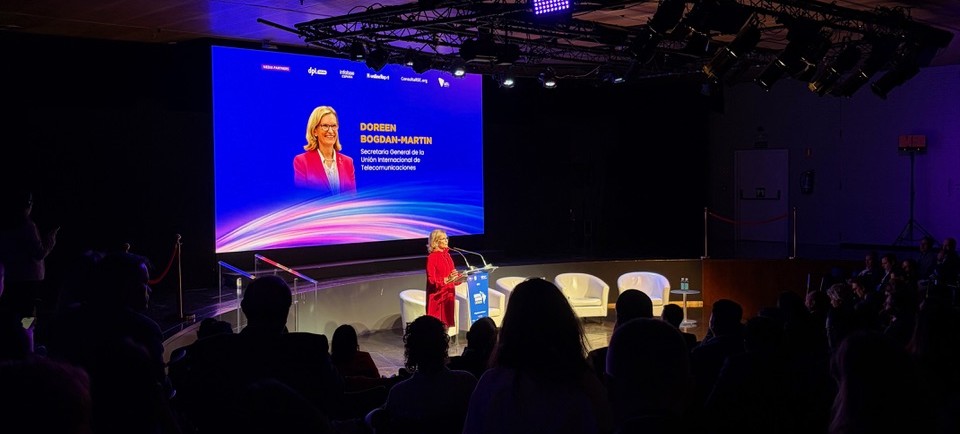
Last week, Madrid hosted the latest edition of the Digital Summit LATAM, and the following question ran through all the panels, in one way or another: can the Ibero-American space build its own Digital Stack, or is it condemned to perpetually be a user of infrastructures, data and rules designed elsewhere?
The map of digital power is, for now, essentially bipolar
There is a starting point that no one disputes anymore, and that is AI is already one of the central geopolitical battlefields of the 21st century, the functional equivalent of nuclear energy in the 20th or steam in the 19th. And the map of that domain has, for now, two clear poles: the United States and China.
Thus, while the United States moves towards what the panelists called digital neoliberalism – that is, a hegemonic leadership led by large technological platforms whose aggregate GDP threatens to exceed that of the nation that hosts them – China represents an alternative model, intrinsically authoritarian, but with a decisive advantage: scale.
In this scenario, Europe and Latin America share a condition that the panelists insisted on naming precisely: that of consumers of artificial intelligence, not producers. This comparison between Europe and Latin America is politically uncomfortable, but it is the starting point to understand the urgency of what was debated in Madrid.
Europe and regulation as an instrument of power
The European reading was perhaps the most sophisticated of the event. Europe does not compete in the production of artificial intelligence, but it has shown that it can turn regulation into an instrument of global power.
GDPR was the laboratory: a standard designed for a market of 450 million people that ended up establishing standards throughout the planet. AI Act is the continuity bet. The key to this strategy lies in a distinction that is often overlooked: the difference between the digital economy and the digitalization of the economy. The digital economy refers to the digital sector itself, in which Europe imports 80% of its products and services. For its part, the digitalization of the economy implies the digital transformation of the existing productive apparatus: the incorporation of digital technologies in traditional sectors—manufacturing, health, logistics, agriculture—to improve their productivity and competitiveness. It is not about creating new digital industries, but about transforming existing ones through tools such as automation, data analysis or artificial intelligence. Europe has decidedly opted for this second strategy, aware that it can hardly compete in the first race.
Although this premise of the EU as a regulatory superpower has been questioned in recent years, the truth is that voices in the sector recognize that European standards continue to be the main global reference frameworks. Although there is not always complete alignment, these remain the main benchmarks against which all others are compared. This is particularly true for Latin America, where the cultural space shared with Europe leads national regulators to closely follow (and sometimes even advance in the same direction) the same regulatory line followed in the EU.
Scale as a condition of existence
If there is one idea that ran through all the panels, it was that of scale. In the digital economy of the 21st century, scale is not a competitive advantage: it is a condition of existence. The rules are made by those who have markets large enough to make them worth following. The EU understood this with the single market. China with its 1.4 billion citizens.
Latin America, with more than 650 million people and a young demographic, has the raw material. But the architecture is missing.
A thesis that resonated strongly was that Latin America will not be a credible digital player until it builds a common digital market with its own regulatory framework. Without ruling out the potential for true regional integration (similar to the European one), what is needed in the short term is something more limited and urgent: a series of common rules, shared data protection standards, mutual recognition of regulatory frameworks, harmonization of spectrum policies, digital identity portability, etc.
The concept of Digital Stack sovereign aims precisely at that: to build its own digital layer that combines infrastructure, services, regulation and data. Not as an alternative for isolation, but as a condition of negotiation with the large hegemonic blocs of the AI era.
Before we can talk about digital sovereignty, however, we have to talk about cables, spectrum and data centers. The Digital Stack cannot be built in a vacuum: it requires a physical foundation on which to operate. And at this point, the diagnosis was somewhat bittersweet. The region has made significant progress in connectivity over the last decade—with notable cases such as Chile, which built more than 230,000 kilometers of fiber optics in four years—but this progress coexists with structural obstacles that slow down the next round of investments: unclear fiscal frameworks, low legal security due to frequent regulatory changes, and business models with margins that do not allow investing in network quality.
The message from the Summit was clear: without its own infrastructure, digital sovereignty is mere rhetoric. A common Ibero-American digital market needs, as a precondition, a regional infrastructure policy that harmonizes access to the spectrum, encourages private investment and guarantees universal connectivity. Not as an end in itself, but as the layer on which all the others are built—services, data, regulation—that make up the Digital Stack.
The paradox of democratization
The panel on AI and digital civilization introduced a tension that deserves special attention. Although AI is presented as a great opportunity to reduce entry barriers in almost all industries and puts capabilities previously reserved for large organizations within the reach of any entrepreneur, the results are generally opposite. The AI sector concentrates power in an extraordinarily small number of players, with just three companies effectively controlling the foundational model market in the United States.
In the digital economy of the 21st century, scale is not a competitive advantage: it is a condition of existence.
For Latin America (and most of the world), this paradox has direct implications: you can use the tools without being able to decide the rules under which they operate. The change, it was insisted, is not technological; but geopolitical, and this is where the alliance between the European Union and Latin America becomes natural, given the cultural closeness and shared interests. And this is where Latin America becomes Ibero-American, since the proposal to add Spain—and Portugal—to this space undoubtedly contributes to the development of multiple layers of Digital Stack in all its parts, while facilitating alignment with Europe as a natural partner.
The role of Spain
Therefore, it is no coincidence that the Digital Summit LATAM is held in Madrid. Spain has positioned itself as a strategic node of the Ibero-American digital conversation, taking advantage of its dual membership in the European space and the Spanish-speaking space. With massive investments in telecommunications, banking and energy in the region, it has its own interests in making this Ibero-American space work. Likewise, in the area of AI, Spanish banking—led by BBVA and Santander—is already acting as one of the main vectors of AI adoption on a continental scale.
While the EU needs scale to project its regulatory model beyond its borders, Latin America needs an interlocutor within the EU who knows its realities. Spain, with its foot on both shores of the Atlantic, appears as the natural actor to articulate that conversation.
A window that may not be open for long
Based on all of the above, Digital Summit LATAM 2026 left an uncomfortable but necessary conclusion: the Ibero-American space is at a key moment of bifurcation. Therefore, either the rules, alliances and infrastructure that allow it to exist as a digital actor with its own agency are built in the coming years; or it will be reduced to being the terrain on which decided games are played in Washington, Beijing and—we will see—Brussels.
Although it is a reflection shared to a high degree between voices on both sides of the Atlantic, the bad news is that time is ticking and the window to act may not be open for long. And we know what happens, that those who do not define their own rules end up playing by someone else's.
***
Mateo García Silva

About the author:Mateo García Silva is a digital policy consultant for the World Bank, where he works on digital governance, data protection, AI and technology regulation in development projects in Africa, Latin America and Asia. Previously he worked as a new technologies lawyer at Cuatrecasas. He has a degree in Law and Political Science from the Autonomous University of Madrid and in International Economics from University of Paris-Est Créteil, and has postgraduate training in law, public policy and digital governance, including an LL.M. in Tech Law & Policy from Georgetown University. He currently researches data governance and AI, with special attention to regulatory and development challenges in the Global South.